v1.0: Lugano, 2023
v1.1: Tokyo, February 2026
v1.2: Basel, June 2026
Contract address: 0x783508684592c83Deb3028d12f1886f08c88B4E7
Meltdown is a generative artwork released as an edition of sixteen pieces. Each piece displays the source code from which it is generated, continuously transforming, melting, and animating it over time. The source code in Meltdown is its implementation but also its form: the source code is simultaneously image, process, and subject. In the latest iteration, a custom syntax highlighter was added: the program highlights its inner workings.
The project was first written in 2023, and is one of the last programs that I wrote entirely by hand. An updated version was presented in Shibuya Tokyo, Japan following an invitation from Noriaki Nakata (NEORT). The current and final version was completed in 2026 exhibited with Nguyen Wahed for Art Basel, Switzerland.
The smart contract is deployed on the Ethereum blockchain and allows to update the source code of the artwork.
All code, thumbnails and the metadata are generated/stored on-chain.
Thank you and acknowledgments:
Mimi Nguyen-Wahed for handling the project and everything around it
Noriaki Nakata for the invitation to present Meltdown on the pillars of the Seibu store in Shibuya
Matthew Ward for the help and guidance in the LED world
Kelly Shi and Yuki Ye from Daisys Visual, US, for their support and for providing the LED panels used in Basel
Meltdown uses bits of the following:
Random class from the thi.ng by Karsten Schmidt (aka Toxi) (Apache-2.0)
MagicProgram from the legendary Plask project by Dean McNamee (MIT)
Andreas
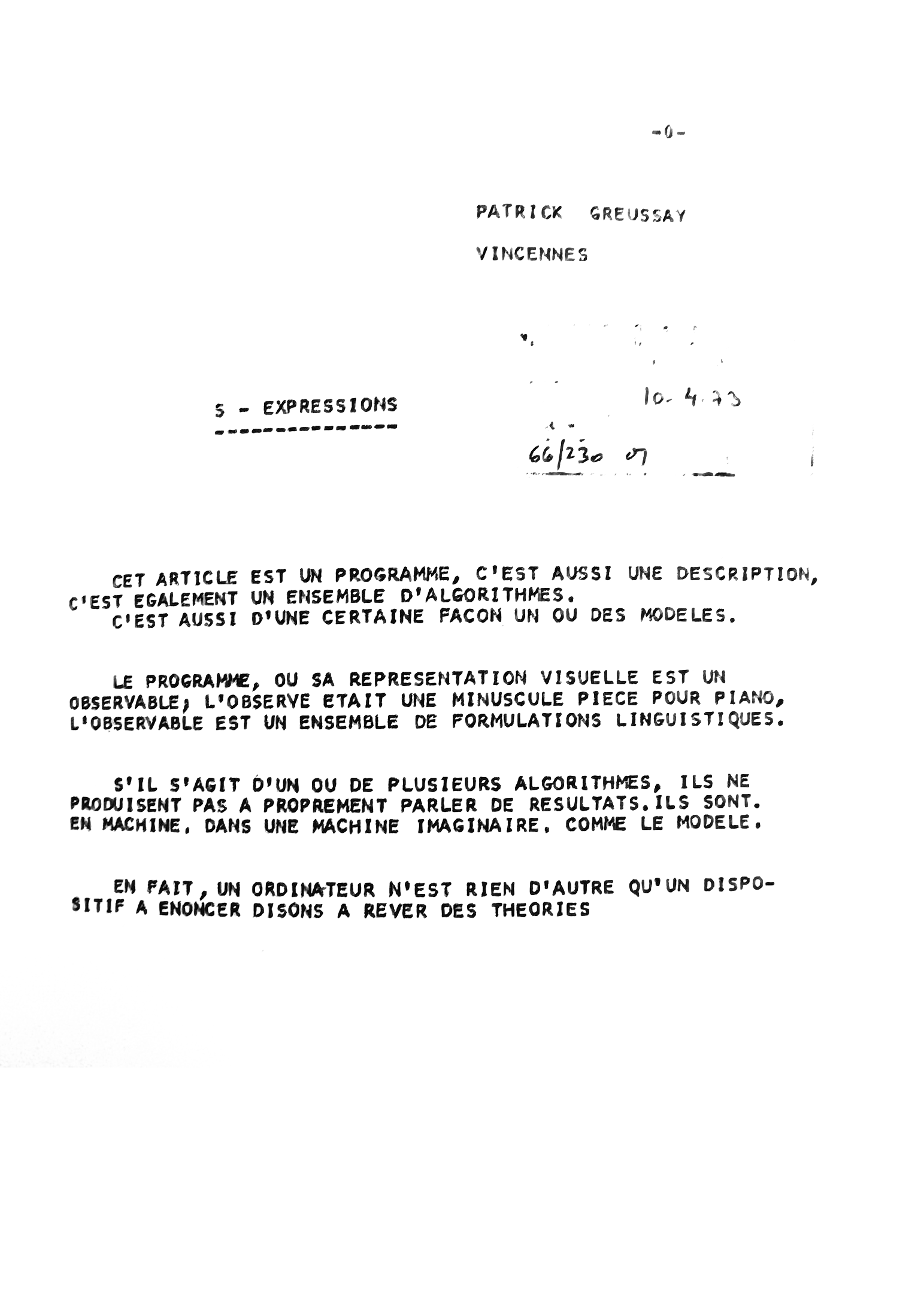
A text describing a program as both an algorithm and a description of itself:
Programming languages are very minimalistic formal constructions, providing only what is necessary to state a problem in a non ambiguous way. Since not all computer science problems are alike, a variety of languages have been developed, each following their own set of rules. What they have in common is an inherent sense of rhythm and structure, due to the repetition of key syntactic elements. Java code looks different than assembler or Fortran. But usually the code which drives the tools we use all day remains unseen, and what a software developer would call “elegant”, or “a terrible mess”, is not visible to the outside world.
In Andreas Gysin’s works, code is used to drive intricate text transformations, turning symbols into seemingly organic entities on screen or into complex imaginary machines. This is satisfying to observe, but there is a twist: often the text that is used as the starting point or “source material” is the very same code that actually performs the transformations. The majority of observers probably cannot understand the code they see on screen, but they are able to feel its graphic quality. As the abstract patterns form into rearrangements and clever shifts over time, the inherent “groove” of the language can be felt. By using code in this way, the artist is providing anti-obfuscation. What usually remains hidden becomes visible, and the inner mechanics of his works are exposed. This is a radically different approach than that of AI and other currently emerging “black box” art. […]
Noriaki Nakata, X, 2026
[…] Andreas Gysin installs his bold, ASCII-inspired work Meltdown as part of DIG SHIBUYA. Some may have noticed that on certain light pillars, LEDs have deteriorated over the years, leaving areas that no longer display anything. Within that context, this work, imbued with glitch-like elements through code and ASCII light, feels generative rather than diminished, even hinting at a spirit of scrap-and-build. Meltdown is a series of dynamic structures composed of text characters, letters, numbers, and various symbols. Resolution-independent, kinetic, and in constant flux, the system gradually destabilizes and reconstitutes its own geometric structure. Compelling work can be created even in environments where resolution is far from high, in an era where social conditions change from moment to moment and various constraints are imposed, what kinds of ingenuity can be brought to bear? Through Meltdown, Andreas demonstrates exactly that.
Just as Seibu once expanded from its headquarters in Ikebukuro into Shibuya(1968), making a significant contribution to Shibuya's culture, there are things that only become visible when you take on new challenges and create movement. Preserving legacy while exploring what comes next, this collaboration is directly aligned with the spirit behind Seibu Shibuya Store’s inaugural participation in DIG SHIBUYA.